Dark web markets work by manufacturing trust between anonymous strangers. The buyer pays the market, which holds the cryptocurrency in escrow until delivery is confirmed, then releases it to the vendor. Reputation, reviews and vendor bonds mimic ordinary e-commerce. But the market itself can't be held accountable and sits on everyone's money at once — which is why every market eventually exit-scams or is seized.
- Escrow holds the buyer's crypto until delivery is confirmed
- The market itself is the one party no one can hold accountable
- Reputation and reviews are manipulable and bought
- PGP protects addresses — but buyers routinely slip
- The model is structurally doomed: exit scam or seizure
Dark web markets look, from the inside, remarkably like ordinary online shops — listings, reviews, ratings, customer service. That familiarity is the point, and it's also a trap. Understanding the machinery reveals why these places are structurally doomed and why the buyer always loses.
Escrow: the core mechanism
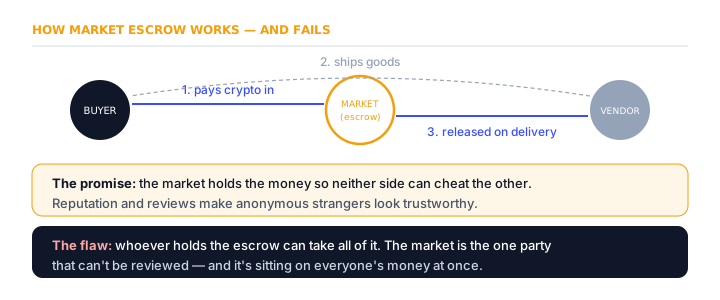
A dark web market isn't really a shop — it's an attempt to manufacture trust between strangers with no legal recourse. The central mechanism is escrow: the buyer pays the market, which holds the cryptocurrency until delivery is confirmed, then releases it to the vendor. In theory this protects both sides. In practice it just moves the trust problem up to the market itself — the one party that can't be reviewed and is sitting on everyone's money at once.
Reputation and vendor bonds
The second mechanism is reputation: vendors accumulate reviews and post a “vendor bond” forfeited for misbehaviour. It mimics ordinary e-commerce — but every signal is manipulable. Reviews are bought and faked; a vendor farms a spotless record on small orders, then cashes in with a big scam. A high rating isn't evidence of honesty; it's evidence the vendor hasn't decided to cash out yet.
PGP and payment
Serious markets require PGP encryption so a buyer's address can only be read by the vendor. Payment is in cryptocurrency — usually Bitcoin or Monero — which the market holds in escrow. This is where most buyers slip: skipping PGP, reusing keys, or pasting details in plaintext that surface when the market is seized.
The life cycle every market follows
Zoom out from the mechanics and a pattern appears that has never once been broken: every market moves through the same four stages, and the last one is always fatal.
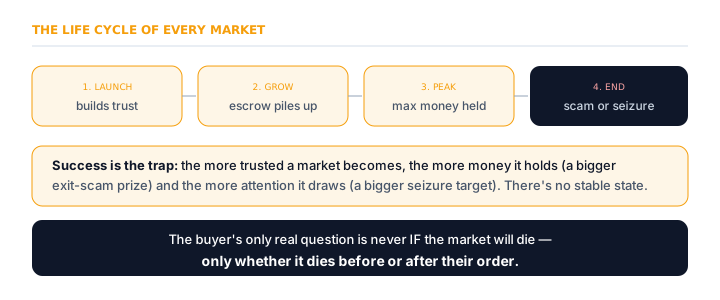
A market launches and works to build trust; it grows as escrow accumulates; it reaches a peak holding the maximum amount of other people's money; and then it ends — always in an exit scam or a seizure. The cruel logic is that success itself is the trap: the more trusted a market becomes, the larger the exit-scam prize it's sitting on, and the more attention it draws from law enforcement. There is no stable end state a market can settle into. It can only grow toward the moment of its own collapse.
Why the model is doomed
The most profitable action a market operator can take is to betray every buyer and vendor at once, freeze withdrawals, and disappear with the escrow balances. Many do exactly that: maintenance shutdowns turn into exit scams, wallets stop responding, and support goes silent. The rest get seized by law enforcement while user funds remain locked in custody. There is no enforceable contract, no insurance, and no legal recourse. Because every participant must trust the operator with their money, the operator is always one decision away from stealing it all. A stable, long-lived, trustworthy dark web market has never existed, and the business model itself makes one impossible.
Why the buyer is the most exposed
It's worth being clear about who actually carries the risk in a market transaction, because it's counter-intuitive. People imagine the danger flows from criminal sellers outward; in reality it concentrates on the buyer. A buyer faces, at once: a vendor who may simply take the money, a market that may exit-scam the escrow, malware bundled into any download, and — if the market is seized or was always a police operation — a permanent record of their orders. Payment is irreversible, there's no chargeback, and anonymity that fails once fails forever. This is why the honest verdict is that no market is safe to buy from, regardless of how polished or well-reviewed it looks.
Frequently asked questions
How do dark web markets work?
A buyer pays the market, which holds the cryptocurrency in escrow until delivery is confirmed, then releases it to the vendor. Reputation, reviews and vendor bonds mimic ordinary e-commerce, but the market itself can't be held accountable — which is the fatal flaw.
What is escrow on a dark web market?
A system where the market holds the buyer's cryptocurrency until they confirm delivery, then releases it to the vendor. It protects buyer and vendor from each other, but not from the market, which holds everyone's money and can seize it in an exit scam.
Are dark web market reviews trustworthy?
No. Ratings are bought, faked, and farmed — a vendor builds a spotless record on small orders precisely to enable a big scam. A high rating shows the vendor hasn't cashed out yet, not that they're honest.
What is a vendor bond?
A deposit an established seller posts to a market, forfeited for misbehaviour. It's meant to signal trustworthiness, but like reviews it can be gamed — a vendor can absorb the bond loss as the cost of a larger exit scam.
Why can't dark web markets be trusted?
Because the market holds everyone's money in escrow and can't be held accountable. The most profitable move available is to vanish with it all, which many do. The rest get seized. No market has ever survived long term.
What is the life cycle of a dark web market?
Every market follows four stages: launch (building trust), growth (escrow accumulates), peak (maximum money held), and end (always an exit scam or seizure). Success is the trap — the more trusted and larger a market grows, the bigger the exit-scam prize and the seizure target it becomes.
Why is the buyer the most exposed on a dark web market?
A buyer faces a vendor who may take the money, a market that may exit-scam the escrow, malware in any download, and a permanent record of their orders if the market is seized. Payment is irreversible with no chargeback, so the risk concentrates on the customer, not the seller.
How do dark web markets make money?
Legitimately-looking markets take a commission on sales and charge vendor bond fees, much like an ordinary marketplace. But the largest ‘profit’ available to an operator is the escrow itself — which is why so many end by simply vanishing with everyone's money in an exit scam.